Orientation
Lights. Camera. Action.
You are here because someone assigned you a podcast. Maybe your professor mentioned it casually at the end of a syllabus overview, or maybe it showed up as a final project with a due date and not much else. Either way, you are expected to produce something you may have never made before, with equipment you may not own, in a format you have never been trained on.
That gap is exactly why this course exists.
This is not a theoretical course about media. It is a working course. You will learn by doing, and what you build here will be real. The environment you are learning in right now, including the videos, the interviews, the studio setups, and the exercises, is itself the product of this course being designed and built in real time. The instructor is making a podcast about how to make a podcast. The students who come after you will learn from what you contribute.
We are all learning together, and the work we do here informs everything that comes next.
The Learning Theory Behind This Course
This course is built on a straightforward belief: people learn best when they do something real, reflect on what happened, and then do it better. That cycle, doing, reflecting, and improving, is borrowed from the same iterative design process we use to build courses. We call it Successive Approximation. You do not have to be perfect on the first take. You have to be willing to take the first take.
The learning science behind this comes from researchers you will encounter throughout the course: Mayer on how multimedia reduces cognitive overload, Vygotsky on how we grow through collaboration and proximity to more experienced practitioners, and Brown, Roediger, and McDaniel on why retrieving information from memory matters more than rereading it. McClusky’s Theory of Margin also shapes how this course is structured, because we know you are a graduate student with a full life, and that load is real.
Warm-Up: Where’s Your Margin?
Before we touch a microphone or a camera, let’s check the engine that runs everything you’ll do in this course: you.
Howard McClusky, an adult educator, noticed something obvious but underrated. Every adult learner walks around carrying two opposing forces.
Power is everything you bring to the table. Skills. Time. Energy. Money. Allies. Confidence. The hours of sleep you actually got last night.
Load is everything pressing down on you. Deadlines. Family. The day job. Self-doubt. The fourteen browser tabs you have open right now.
The space between them is your Margin. Margin is the breathing room left over for new learning, surprises, and growth. When Load creeps up on Power, your working memory fills, your patience thins, and even small new ideas feel heavy. That’s cognitive overload in plain English. When Power outpaces Load, you have room to experiment, fail forward, and try again. That extra room is where real learning happens.
Slide the ruler to where you honestly sit right now. Not where you wish you were. Not where your LinkedIn says you are. Where you actually are this week.
McClusky’s Theory of Margin
McClusky Power–Load–Margin Tool
So, What Do You Do With That?
Wherever the ruler landed, that’s your starting line. Not a verdict.
If your Load is heavy, lighten it:
- Break the course into short sessions instead of marathon ones
- Start with the free tool stack (DaVinci Resolve, OBS, Blackmagic Camera app) before investing money you don’t need to spend yet
- Skip the perfectionism trap on your first take; this course is built around iteration, not first-pass mastery
- Swap rigid scripts for bullet points, a tip we’ll borrow from broadcaster Jason Rainey
If your Power feels low, grow it:
- Use the demonstrations and flash cards as retrieval practice; revisiting beats re-watching every time
- Find one accountability partner, in the cohort or in your own circle
- Schedule your study windows like appointments, not “if I have time”
- Celebrate small wins. Finishing one lesson is genuine progress
Here’s the andragogical truth: you are the driver. This course is built to widen your margin, not narrow it. Every module is modular for a reason. Every demonstration is on demand for a reason. You decide the pace; the structure holds the rigor.
We designed this course to respect your time and your intelligence. You will not be lectured at. You will be oriented, activated, and then put to work.
Finally, a practice of recall. We want you actively trying to remember even if you don’t immediately. Throughout you will find flash cards and low stake quizzes, don’t worry about your scores. We want you actively engaging in recalling material from the lessons.
What You Can Expect
This course works in two pathways depending on your situation. If you are working through it with a cohort, you will collaborate, teach each other, and run production exercises together. If you are working through it alone, scaffolding is built in at every stage to support you without requiring a partner.
Both paths lead to the same outcome: a published podcast you made yourself.
Along the way you will watch short instructional videos produced in Peregrine Digital Studio, hear from industry professionals with real broadcast and radio experience, complete low-stakes recall exercises designed to strengthen memory rather than grade it, and work through production scenarios that mirror real-world challenges. The exercises are not hypothetical. They are based on things that actually go wrong on set.
You will also be asked to reflect. Not in the generic journaling sense, but in the specific sense of examining what you perceived, how you processed it, and why it changed the way you think about the work. That is Mezirow’s reflection taxonomy in practice, and it works.
Course Objectives
Upon completing this course, you will be able to:
- Identify the five primary podcast formats and select the appropriate format for a given academic assignment based on content goals and production capacity.
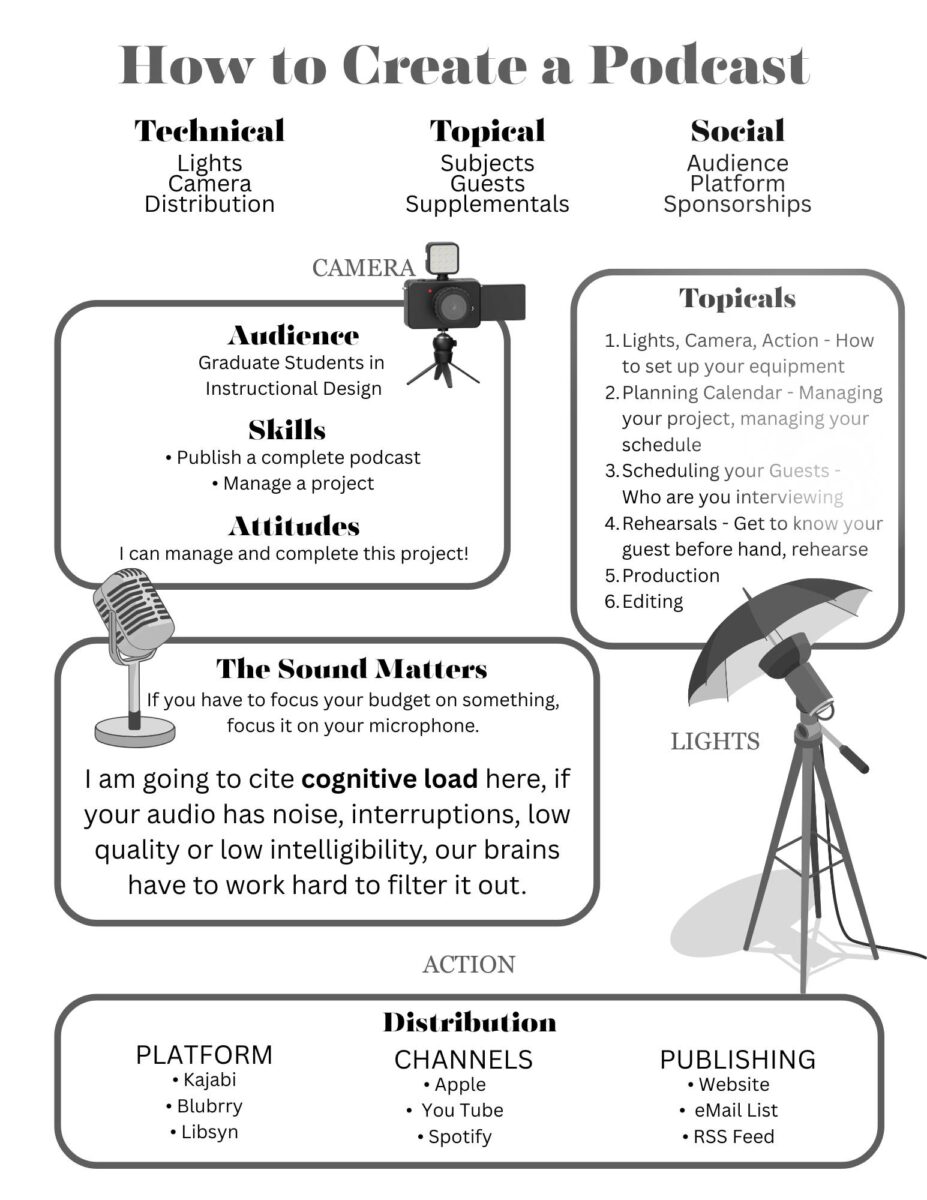
- Apply the Lights, Camera, Action framework to plan and execute a podcast production environment, including set design, audio capture, and camera framing.
- Demonstrate mic discipline, basic audio monitoring, and equipment selection appropriate to your production context, from smartphone to multi-mic studio setup.
- Conduct a structured interview using prepared questions, active listening, and on-the-fly redirection when a guest goes off topic.
- Collaborate with peers in defined production roles, teach your role to someone else, and learn another role in return through the Jigsaw production exercise.
- Analyze an existing podcast for production quality, structural integrity, and design choices, and articulate specific recommendations for improvement.
- Plan, record, edit, and publish an original podcast episode that demonstrates mastery of the full production workflow covered in this course.
Expected Outcomes
By the time you finish this course you will have a completed, published podcast. You will also have a practical production vocabulary, a working understanding of how audio and video interact in a multimedia learning environment, and a repeatable process you can bring to any future assignment or professional project that requires recorded media.
More than that, you will have made something. Not a summary of someone else’s podcast. Your own.
Course Task List
Pre-Assessment: Complete the self-evaluation to establish your starting point and activate recall mode before the first lesson.
Module 1 — Types of Podcast: Identify and distinguish the five primary podcast formats. Complete the format identification activity.
Module 2 — Lights: Environment, set design, and lighting technique. Field observation and reflection.
Module 3 — Camera: Framing, stability, aspect ratio, and video-to-audio relationships. Equipment tier exercise.
Module 4 — Action: Interview craft, question sequencing, guest management, and content direction. Practice interview exercise.
Module 5 — Production Roles Jigsaw: Take a role, solve a production problem, teach your role, learn another.
Module 6 — The Remix Project: Deconstruct a provided podcast. Diagnose what works, what fails, and what you would change.
Module 7 — Final Project: Plan, record, edit, and publish your original podcast episode. Submit with a production reflection.