LEARNING OBJECTIVES
After completing this lesson, you will be able to:
1. Describe the three-stage production framework (pre-production, production, post-production) and explain why pre-production determines the quality of everything that follows.
2. Build a three-act question architecture for a podcast interview.
3. Create a guest communication timeline from initial invitation through the day of recording.
4. Apply clock management using a pie chart to allocate time segments within an episode.
5. Develop a fallback plan for common production failures.
6. Explain why content quality overrides production quality.
—
VOCABULARY
Pre-Production: Everything that happens before you roll the cameras. Includes concept development, guest communication, question writing, equipment verification, location scouting, and technical rehearsal. John Elias identifies pre-production as the most important stage of any production, regardless of scale.
Production: The active recording phase. Cameras are rolling, microphones are live, and the interview or content capture is underway. The quality of this phase is largely determined by the quality of your pre-production.
Post-Production: Everything that happens after recording stops. Editing, color grading, audio mixing, exporting, and distribution. Covered in detail in Lesson 8.
Question Architecture: The deliberate structure of interview questions organized into three acts: Establishment (who is the guest), Deep Dive (the core topic), and Wisdom (reflection and forward-looking insights). Designed to create a natural conversational arc.
Pie Chart Timing: A time management technique from live radio production where the total episode length is divided visually into segments using a pie chart. Each segment is allocated a specific duration. The chart can be placed under a clock during recording for real-time pacing awareness (J. Rainey, 2026).
Fallback Plan: A predetermined backup strategy for when equipment, guests, or circumstances fail during production. In live radio, fallback planning is standard operating procedure because something always breaks. The same discipline applies to podcast production (J. Rainey, 2026).
Chunking: Breaking a complex process into smaller, manageable component parts. In production planning, this means addressing audio, lighting, guest prep, and equipment as separate tasks rather than one overwhelming project
Pre-Interview: An informal conversation with the guest before recording begins. Used to build rapport, discuss the interview arc, identify topics to avoid, calm nerves, and conduct a technical rehearsal.
Technical Rehearsal: A 30-second test recording where the guest states their name and answers a casual question. Played back immediately to show them how they look and sound on camera, building confidence in the setup.
Episodic Plan: A content calendar for your podcast that schedules topics, guests, and production dates in advance. Consistency in publishing builds and retains audience. Successful podcasters publish on a reliable schedule, even recording from hotel rooms while traveling (J. Elias, 2026).
CORE CONCEPTS
The Three-Stage Framework
John Elias frames all production work, from solo podcasts to major concert productions, within three stages: pre-production, production, and post-production. Pre-production is everything before cameras roll. Production is the recording itself. Post-production is everything after. He is clear about the hierarchy: if you get your pre-production right, you will make fewer mistakes in every stage that follows.
For podcast production, pre-production includes concept development, guest outreach and preparation, question writing, equipment verification, location assessment, lighting and sound checks, and fallback planning. The amount of time spent here directly correlates with the quality and efficiency of the recording session.
Chunking Complexity
The instinct when facing a podcast recording is to think about everything at once: audio, video, lighting, guest, questions, equipment, schedule. That aggregate complexity is what overwhelms new producers and causes them to freeze or cut corners.
John Elias’s advice is to break it into component parts. Spend time on your audio plan. Then spend time on your lighting. Then handle guest communication. Then check equipment. Each component by itself is not hard. It is the jumble that paralyzes.
Guest Preparation Timeline
Your interview will only be as good as your guest is prepared to be. An anxious, unprepared guest gives stilted, forgettable answers. A prepared, relaxed guest gives you gold.
Two weeks before recording: Send a welcome email that includes why you invited them specifically, what topics you want to explore, approximate interview length, date/time/location, and wardrobe guidance (solid colors, avoid patterns, avoid pure white or black).
One week before: Send the specific questions you plan to ask. Yes, share them. This helps the guest organize their thinking and deliver stronger answers. Include prep materials, technical details (parking, entrance, arrival time of twenty minutes early for setup).
Day before: Confirmation text or email. Wardrobe reminder. A warm note: “Looking forward to tomorrow.”
Day of: Twenty minutes before recording, conduct the pre-interview. Walk them through the set. Show them the cameras. Explain the arc of the interview. Ask about any topics they prefer to avoid. Then run a technical rehearsal: thirty seconds of the guest stating their name and answering a casual question. Play it back for them. This calms nerves and builds trust.
Question Architecture
Build your questions with intention, not just a list of things you want to know.
Start with research. Google your guest. Read their recent work. Note career chronology. Identify threads you want to follow. Then organize your questions into three acts. The following is a one hour format. Tailor it to your length.
Act One, Establishment (5-10 minutes): Who are you? What do you do? What is your origin story? These are warm-up questions that get the guest talking comfortably. The easiest possible opening is: “Just to confirm, you are [name], and you are the [title] at [organization], is that right?” It gets them talking, confirms audio, verifies pronunciation, and provides a clean starting point.
Act Two, Deep Dive (20-30 minutes): Your main topic questions. The material that made you want to interview this person. Build from general to specific. Place your most compelling question in the middle of Act Two, when energy might flag and the conversation needs a spark.
Act Three, Wisdom (5-10 minutes): What have you learned? What advice would you give? What is next for you? These forward-looking questions create memorable closing moments. And always end with: “Is there anything I did not ask that you wish I had?” This question often produces the best moment of the entire interview.
Clock Management
Jason Rainey spent years producing live morning radio where every second was accounted for. His core insight applies directly to podcasting: manage the clock.
The clock is more important than your question list because everyone is bargaining in time. Your audience fits your show into a commute, a walk, or a lunch break. You owe them respect for that time (J. Rainey, 2026).
Jason’s technique is a pie chart. Take your total episode length and divide it visually into segments: intro, segment one, segment two, transition, segment three, outro. Assign each a specific duration. Place the pie chart under a clock on your desk during recording. As minutes pass, you can glance down and see exactly where you should be.
It sounds like restriction. It is actually freedom. When you know your time budget, you stop worrying about pacing and start focusing on the conversation. Without time awareness, you end up with a forty-five-minute recording where the first twenty minutes wander aimlessly and the last ten minutes rush through your best material.
Jason’s additional recommendation: until you are ready to go longer, cap your episodes at one hour. Put a leash on it until you know what you are doing.
Production Clock
Clock Your Show
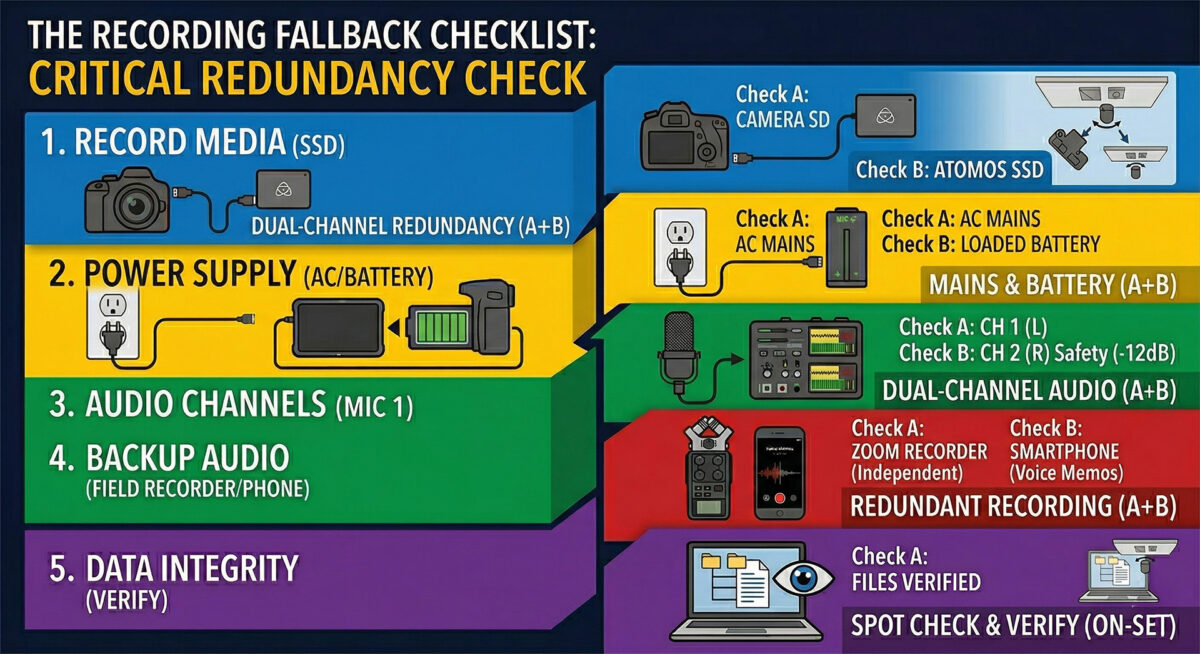
Fallback Planning
In live radio, Jason Rainey was always thinking about the fallback. When this cart machine dies, what is the backup? When this CD player skips, where is the spare? When the show goes on the road, what happens if the signal drops? His mindset: always have a plan for when things fail, because they will.
For podcast production, your fallback checklist includes: Is a backup recording device running (phone as backup camera, separate audio recorder)? If the guest cancels, do you have a solo episode concept ready? Did you verify battery levels on every device? Did you confirm hard drive and card space? Did you test all cables and connections before the guest arrived?
Jason’s own interview for this course demonstrated the lesson perfectly. Batteries died. Memory cards filled up. His response: “That is pre-production. You have got to think about that.”
Content Over Production
John Elias offers the most important pre-production principle of all: content overrides everything. You could have the best cameras, the best lighting, a team of fifty people with the best editors in the world. If your content is not interesting, none of that matters. A few people might notice the lighting. Everyone else clicks away.
Pre-production is where you ensure your content is worth recording. Know your topic. Research your guest. Have something to say that somebody else wants to hear. Then build the technical side to support that content, not the other way around.
Episodic Planning
Consistency matters. John Elias observes that successful podcasters publish on a reliable schedule. When viewers expect a new episode every Monday and it does not appear, interest declines. Miss two Mondays and ratings drop measurably. Some of the most committed podcasters he has seen record from hotel rooms on vacation rather than miss a publishing date (J. Elias, 2026).
For your pre-production planning, create an episodic calendar that maps out your next four to six episodes: topic, guest (if applicable), recording date, editing window, and publish date. This forward planning prevents the scramble of figuring out your next episode the day after you publish.
—
SCENARIO BOX: The First Interview
You have scheduled your first podcast guest for next Tuesday. Today is Monday of the previous week. Here is your pre-production sequence.
Today: Send the welcome email with topics, timeline, and wardrobe guidance. Wednesday: Send the specific questions and technical details.
Friday: Begin equipment verification, charge all batteries, clear all cards, test all connections, set up your recording space using the lighting and framing principles from Lessons 2 and 4.
Monday: Send confirmation text. Prepare your fallback plan (backup recording device charged, solo episode concept ready).
Tuesday morning: Set up two hours early. Run through your pie chart timing. When the guest arrives, walk them through the set, do the pre-interview, run the technical rehearsal. You are ready.
GRADUATE STUDENT TIP
Over-preparation can be as harmful as under-preparation. Jason Rainey specifically said he avoids sending preparation questions to interview guests because it produces rehearsed, less honest answers. That works for his conversational interview style. For a structured educational podcast, sending questions helps the guest deliver stronger, more organized content. Know which approach fits your format. For your capstone project, send the questions. For a casual conversation podcast, use bullet points and let the discussion breathe.
HANDS-ON EXERCISE:
Build Your Pre-Production Package
Step 1: Select a real or hypothetical guest. Research them for 30 minutes. Take notes on their career chronology, recent work, and potential threads.
Step 2: Build a three-act question set with at least 3 questions per act. Identify your single most compelling question and place it strategically in Act Two.
Step 3: Draw a pie chart allocating time for each segment of a 30-minute episode. Label intro, Act One, Act Two, Act Three, and outro with specific minute allocations.
Step 4: Write the guest welcome email you would send two weeks before recording.
Step 5: Write your fallback plan. What happens if your main camera stops? If the guest cancels? If you run out of storage?
SELF-CHECK QUESTIONS
1. What are the three stages of production, and why is pre-production the most important?
2. What does “chunking” mean in the context of production planning?
3. How far in advance should you send a guest their interview questions, and why?
4. Describe the three acts of a question architecture.
5. Why does Jason Rainey recommend using a pie chart for time management?
6. What is a fallback plan, and why do you need one?
7. According to John Elias, what overrides all technical production quality?